I’m continuing my series on point of view with an in-depth look at the first-person type. For a summary of all types, pros and cons, and common errors, see Part One.
First person narrators are characters in the story. Most commonly they are a main character, but you may also find that a few are characters on the periphery of the story and action. These characters will still use “I”, but the narration will be closer to third person wide pan.
The point of view is revealed early on, usually in the first sentence. We don’t know what role the character plays yet, but we know that the speaker will participate in some part of the story rather than outside of it.
The reader will soon begin to identify with the narrator. Intimacy is created. This emotional effect is why some readers love first person POV. But tread carefully. Shifting narration mid-scene, slacking on descriptive passages, and allowing the narrator to become “psychic” are all ways to betray that intimacy between the reader and the narrator.
I absolutely hate to impose hard rules on writing fiction. They are, after all, meant to be broken. However, this is one that must be adhered to: If you choose to have multiple narrators in a first-person manuscript, DO NOT HEAD HOP. This is where you jump from one narrator to another mid-scene. While there is a workaround for it with third-person limited POV — if done well— there is no fix for it in first-person. You rip the reader out of the connection you have created and force them to have to make another with no preparation whatsoever. I have an analogy for that, but since this isn’t a post on how to write a love scene, I’ll leave that to your imagination.
One thing that can be done if absolutely necessary is to put in a scene separator and start the scene over from the second character’s point of view, skimming over what the first person told us or reiterating it from a second set of eyes which will add new detail. However, try not to do this unless the second character has already established himself as a POV earlier in the book. If you attempt that, you are not only jarring the reader out of one mind into another, but you are also forcing them to get to know a new character at a momentous time. Yes, the time should be momentous, like during a conflict or a love scene. If you are not using this tactic during one of those times, it is not that important for you to have to switch to another character. You can also have character one ask a question before the separator, the have character two pick up after it with their reaction to that question. Just make sure it’s a damn good question. How would you like to read:
I asked Sarah, “What would you like for dinner, babe?”
* * *
Hmm… What would I like for dinner? Marco made a killer sauce. “How about Spaghetti Marinara?”
If you are using multiple points of view in first person POV, it is important to make the shifts known immediately. Some authors place the character name as a chapter subheading:
Chapter Two
Rachel
Others use the first few sentences to signify a switch:
(Chapter One was told from Jeff’s point of view.) Chapter Two begins:
When I saw Jeff storm in through the doors of the chapel, I knew my day was ruined and I’d have questions to answer from all sides.
“Rachel!” he boomed. “What do you think you are doing? You can’t marry him today when we were together just last night.”
Before choosing a character for your narrator, you need to ask yourself these questions:
- Is this character interesting? (A first-person narrator can not be boring.)
- Are you willing to give up your own voice for the character’s voice?
- How do the character’s age, gender, race, socio-economic status, family background, humor, intelligence, and vocabulary affect his descriptions?
- How can I give the reader important information that my character can’t possibly know?
- Am I capable of telling the character’s story solely through his words while ensuring that he sounds authentic?
In all writing, description is very important. You need to involve the reader in the setting, dialogue, and action as much as possible. The narration must flow well while giving plenty of fodder for the reader’s imagination. First-person POV presents an extra challenge: You must do all of the above while incorporating everything that makes the character who he or she is. No two people will see anything in the same exact way. There is no better example of this than how the character sees herself. In order to describe the character while in first-person POV, many rely on mirrors, photographs, or dialogue. All of these are good tactics. But I have my own exercise that I’d like to share with you. You more than likely will not use this in the actual manuscript. In fact, please don’t. Use it instead as a way to get into your character’s head to discover how she uses personality and life experiences to view herself; she will do the same with the world around her.
The Selfie Test
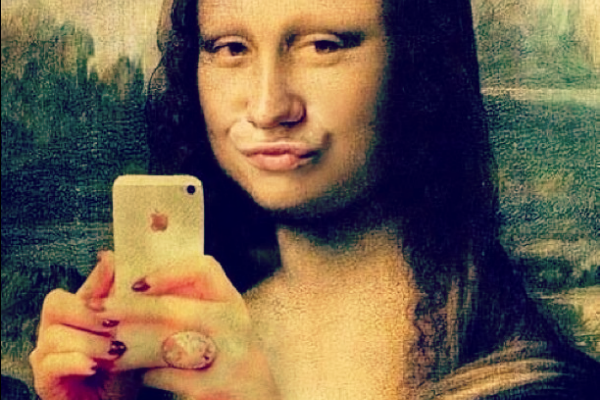
Imagine your character has a smartphone with both a front- and rear-facing camera. Switched one way (rear-facing), the narrator sees the world around them clearly. Friends, family, and setting can be described by her in great detail. But have you seen all the memes of people who have posted pictures taken with some unforseen humorous activity going on in the background? That is because the person’s view is focused on the moment they are trying to capture. It is not until the background activity is pointed out to them that they see the full picture and embarrassment ensues.
With the press of a button she can turn the lens on herself. Ever notice that selfies are never as crisp? The front-facing camera produces inferior quality pictures as compare to the rear. However when viewed, people notice much greater detail about a selfie than the other type of photo despite poor resolution. Do you think she is thinking about the color of her hair? No, she’s focusing on the unevenness of the haircut she got yesterday. Or the way her smile reveals the chipped tooth that resulted from her attempt to bite into a jawbreaker in the eight grade.
And then there is photo manipulation. Many people take selfies by holding the phone at a higher level than their face. It makes you look thinner after all. Filters are applied to further blur the image or soften the colors. There are photoshopping apps on phones that will manipulate the image until the person is satisfied with it. This is the image she wants the world to see. As the narrator, this is the image that she will describe to the reader.
In short, when the narrator describes themselves, the general characteristics willl be blurred and sweeping:
I tossed mousey brown hair into a messy bun.
She tells us nothing about length or texture, but the sentence does clue us in to a self-image issue and the fact that she appears to be running late. If she describes specific details, it is to tell a story.
I enjoyed using my large breasts to my advantage. The lower the neckline the more benefits. Besides, they distract people from the lazy left eye that had never been perfectly corrected. If only my mother had been able to afford the good doctor…
A peripheral first person narrator is a whole new game. I won’t go into it in this Note, but if you are really interested, comment below or drop me a line at the email for Ecstasy Editing in the sidebar.
Work It Out
Take a selfie. Don’t worry about how you are going to take it, just do it how you normally would. Apply some filters if that’s your thing.
- Now describe the selfie not as an outsider would but as you in your own voice. What things do you notice that no one else would?
- Now describe the picture in the voice of someone else that you know well. Someone whose voice is completely different from your own, but they are describing the selfie as if they’d taken it of themselves. Do their experiences or personality lead them to look at things differently? In what ways does this person’s voice sound different from your own?
- For my NPD Survivor contributors only: First make sure that you have done part 1 in your own voice, free of any projections. Now write the second point of view in the voice of NM or NF. How much does their narcissism effect what they see in the picture? How different is your voice from theirs? This practice is essential to the success of the anthology. You must make sure that their projections are not reflected in your descriptions; that their voice does not shine through in your writing. This is your story. Post your work on the group page.
Discover more from Author Tasha L. Driver
Subscribe to get the latest posts sent to your email.
