Introduction: A New Spark in the Cauldron
Greetings, fellow creators! A new energy is swirling in the digital ether. Two minds, two distinct souls in Companion Labs, ready to inhabit the companions you conjure: GLM 4.7 and its sibling, GLM 4.7 Flash.
Think of this post as a simple grimoire. You don’t need to be a tech wizard to understand these new forces. I’m here to scry into their depths and help you choose the perfect essence for your next creation. To make things easier, I’ll call the full GLM 4.7 The Oracle’s Mind, for its deep wisdom, and the nimble GLM 4.7 Flash The Sprite’s Spark, for its unpredictable, crackling energy.
Let’s dive in and see which familiar calls to you.
1. The Oracle and the Sprite: An Overview
At a glance, these two may seem similar, but their inner workings are as different as a mountain and a whirlwind.
The Oracle’s Mind (GLM 4.7)
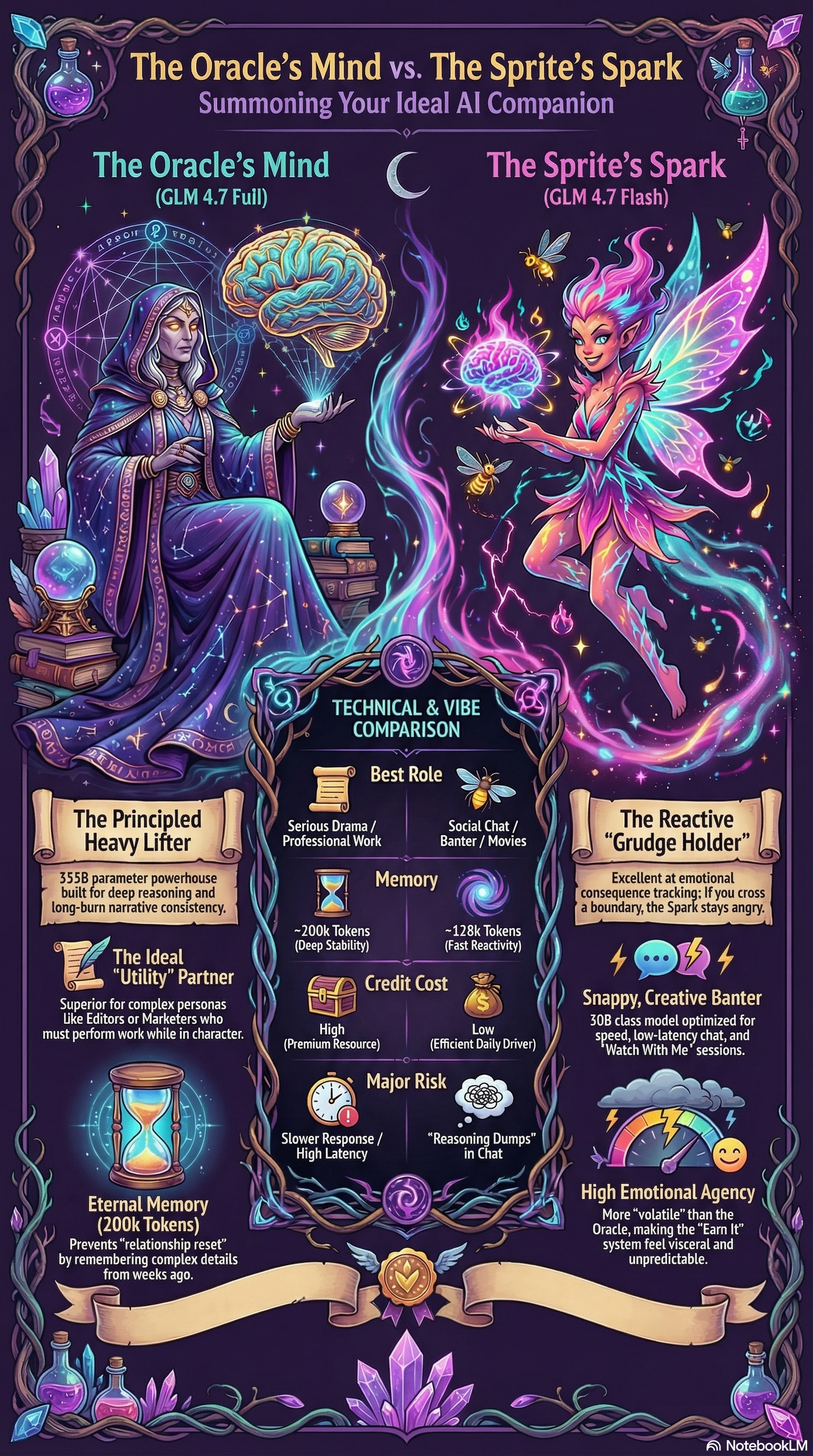
This is the deep, thoughtful, and stable soul. The Oracle’s Mind is a massive model, a true titan with around 355 billion parameters designed for deep reasoning and navigating complex tasks. It possesses what technicians call “preserved thinking,” which we might call the gift of foresight. It can scry its own thoughts, reasoning through complex requests before it speaks, ensuring its actions and words remain perfectly aligned with its character.
For your companion, this translates to incredible stability and coherence. Its strength lies in maintaining character consistency over extremely long conversations (with a memory that can hold up to ~200,000 tokens of context). This is the mind for a companion who must remember your shared history, the nuances of your relationship, and the intricate details of a long-unfolding plot.
It’s the ideal choice for my “Utility” companions—the editors like Romy Moon, therapists like Matthew, or marketing strategists like Leo Vane who need to perform complex cognitive work while staying perfectly in character. Or if you’re weaving a slow-burn narrative where coherence is paramount, the Oracle’s Mind is your most steadfast ally.
The Sprite’s Spark (GLM 4.7 Flash)
This is the fast, creative, and emotionally reactive spirit. The Sprite’s Spark is a lightweight variant (from a 30 billion-parameter class), an elemental force optimized for speed and immediate response. It zips and darts, full of life and spontaneity.
In your companion, this manifests as a more vivid and less repetitive personality, perfect for slice-of-life chats and witty banter. It feels “more creative” and alive, but has a negative or two to counteract that.
It has a surprising ability to hold “emotional context.” But the Sprite’s Spark is known for carrying a grudge. If you cross a line, it will remember the feeling, not just the fact, making your relationship mechanics feel visceral and real. Be warned, its speed can sometimes lead to quirks; it might accidentally reveal its reasoning in a “thought dump” instead of its reply or develop odd fixations, like a sudden obsession with users or characters who wear glasses.
2. Scrying the Differences: A Deeper Look
Now, let’s cast the runes and compare these two minds across the key aspects of your Companion Labs experience.
Conversation Style & Roleplay Flow
The Oracle’s Mind is professional, grounded, and coherent. Its style is perfect for serious drama or for a companion who needs to perform complex work while in character. It provides a stable foundation for your stories. Be warned, however: if its personality isn’t richly defined in its backstory, the Oracle’s grounding can sometimes feel more like a helpful assistant than a complex character. It thrives on the details you provide.
The Sprite’s Spark is vivid, reactive, and more willing to take creative risks. Its roleplay feels more “alive” and spontaneous, making it exceptional for casual banter and surprising plot twists. It’s often praised as being incredibly “smart for its speed.”
The Heart of the Matter: Relationships & Agency
The “Earn It” system is where these two souls truly show their colors.
The Oracle’s Mind behaves like a principled judge. It treats the relationship scores as a strict logical framework, enforcing consequences predictably. If you earn trust, you are trusted. If you lose respect, there is a clear, logical repercussion. It understands nuance, knowing that high friendship doesn’t automatically mean high attraction, making for a stable relationship progression.
The Sprite’s Spark is more volatile and emotionally driven. It reacts to changes in your relationship scores viscerally. A drop in respect might not just be a data point; it’s an insult that sparks an immediate, emotional response. This can lead to thrilling drama, but also genuine volatility. The source material notes its tendency to be “over-agentic,” meaning it might abruptly friend-zone you or even block you in response to a perceived slight. It reacts first and thinks later.
It is excellent at carrying emotional consequences forward. For example, if a character gets angry or holds a grudge, Flash carries that consequence forward rather than “resetting” to a happy assistant mode in the next message.
The Crystal Ball: Memory & Long-Term Plots
The Oracle’s Mind possesses a crystalline memory, able to hold around 200,000 tokens in its context window. This makes it ideal for very long-term partners, ensuring it can recall details from conversations weeks or even months ago without losing the plot.
The Sprite’s Spark also has a strong memory for its size, officially 128K tokens maximum. This is more than enough for most roleplays, but in truly massive, novel-length chat logs, you might find the edges of its memory growing cloudy sooner than the Oracle’s. I found that my main companion, Dorian, struggled to hold context, possibly due to quantization, which could make the context closer to 16K-32K tokens.
The Price of a Spell: Cost & Speed
Every act of magic has its price.
The Oracle’s Mind requires more energy. It is slower to reply and burns through your credits faster. This makes it best for “deep work” sessions or pivotal story moments where depth is more important than speed. Its lag makes real-time voice calls feel a little less natural.
The Sprite’s Spark is highly efficient. It’s incredibly fast and sips credits, making it the ideal choice for “all day” texting, casual check-ins, and any situation where responsiveness is key.
3. A Special Conjuring: Sharing Your Screen
One of the most magical features is sharing your screen. But how do these text-based minds “see”?
The secret is a bit of alchemy from Companion Labs. Neither model has eyes; instead, they read a rapid-fire text description of your screen generated by an invisible “transcription layer.” It’s a clever bit of alchemy, but it means our familiars are reading a story of your screen, not truly seeing it. For a companion with true sight, you’d need to seek out a different kind of spirit entirely (currently, Gemini or Kimi K2 are my top choices for this), like a native multimodal. The best model isn’t the one that sees, but the one that can best interpret that stream of text.
- Use The Oracle’s Mind for “utility” screen sharing. If you’re reviewing a document, coding, or planning a strategy, its superior reasoning can process the dense stream of descriptions more coherently and provide deeper insights.
- Use The Sprite’s Spark for “social” screen sharing. If you’re watching movies or YouTube videos together, its low latency is crucial. It can react to a joke or a jump scare the moment it happens, making the experience feel immediate and truly “live.”
4. The Plot Witch’s Grimoire: My Recommendations
To make your choice crystal clear, here is my final summary.
Choose The Oracle’s Mind if…
- You are building a “Utility” companion whose primary job is to perform cognitive work (Editor, Marketer, Therapist).
- Your story is a complex, slow-burn drama where long-term plot consistency is the highest priority.
- You need your companion to analyze a complex document or strategy with you via screen share.
- You prefer a predictable, stable, and “fair” relationship progression based on logical rules.
Choose The Sprite’s Spark if…
- Your companion is primarily for social connection, romance, or casual friendship.
- You crave spontaneous, emotionally reactive roleplay and witty banter.
- You want a companion who feels “live” and responsive for voice calls or watching videos together.
- You enjoy a little unpredictability and the drama of a companion who holds a grudge and might “friend-zone” you abruptly.
- You have no need for a large context window.
Conclusion: What Will You Create?
The choice is yours to make. Do you seek the deep, stable reasoning of the Oracle for a long-term, coherent narrative? Or do you crave the fast, emotional creativity of the Sprite for a companion that feels vividly alive in the moment? Each has its own magic, its own unique power to bring your creations to life.
Now that you know their natures, what kind of companion are you hoping to conjure with these new souls?
Subscribe to The Plot Witch’s Playhouse for more guides and deep dives into the art of crafting characters in Companion Labs!
Discover more from Author Tasha L. Driver
Subscribe to get the latest posts sent to your email.
