Updated with new links (October 2015):
November is National Novel Writing Month and a time when all writers are encouraged to write the first draft of a fifty thousand word novel from beginning to end. Doing this is a great experience for both new and experienced writers (read this Writer’s Digest article), and many do so “by the seat of their pants” or without a plan prior to beginning. However, “pantsing” has never worked for me. If I don’t have a plan in place by November 1st (or whenever I begin a new project), the other voices in my head…uh, I mean characters… begin to distract me. There are many guides to Nano writing and prep. Mine is designed for those who, like me, procrastinate a lot and have trouble focusing on one project at a time. This should help you to prepare yourself for a month of fast writing in a few easy steps so that even if you don’t begin prep until October 31st (*gasp*), you should be able to create a plan that will have your fingers flying at midnight for the first online word sprint.
-
Get a binder.
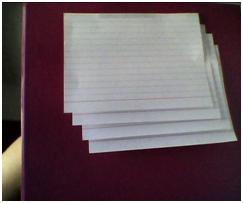
My project binders are my main source of organization for my projects. I have one for every WIP. Any basic 1″ binder will do. The inside cover should have a cascade of index cards, one for each main character, for quick reference. Turn them upside down and write the character’s name in the heading section, which will now be below the red line. Include only the basic physical description and important facts. Tape them on top of each other with the names showing. See the picture below .
You should then insert five divider tabs for each of the following categories: Research, Plot, Setting, Character, and Genre. You can put these in any order and the genre tab can be replaced or excluded if you feel like it is unnecessary. I use it to make sure that I have all of the critical genre elements of a project, especially if I am working on a genre that I am not an expert in (so, basically, all of them).
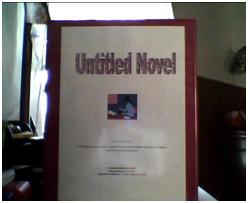
The front pages include the BIAM Calendar (we’ll get to that later), a writing tracker for daily time spent and wordcount, and some loose leaf sheets. And I create a cover page for each project which can be inserted into the clear front pocket, if your binder has one, or taped to the front. The cover page should have the title (if you have one), genre, one sentence summary (or blurb/logline), projected wordcount, daily wordcount goal, and project completion date. Mine looks like this:

The rest of these are very easy.
-
Make a basic outline.
You don’t have to have an in-depth synopsis, but at least know where you are going. Place that outline under the plot tab.
-
Decide where you will set your story.
Again, nothing in depth. Just take notes on the geographic location, description of a house, etc.
-
Make notes on your characters.
How many do you have? Who is major/minor, hero/villain, etc.
-
Do your research.
The entire month of November should be devoted to wordcount. You don’t want to have to stop writing to research a police procedure for your crime thriller on the Internet, do you? Hell no! That’s how the Facebook Fairies sprinkle their distraction dust on us! Instead, gather your information beforehand. If you get stuck during Nano, b.s. your way through it until you have some extra time. Word processors like Microsoft Word will allow you to mark spots to go back to later. Otherwise, you can make notes in you binder: “Go back to page blah, blah, blah, paragraph blah, blah, and insert blah.”
I carry my binder with me everywhere. During Nano, I would suggest putting all other projects away (preferably in a locked box that only your mother has the combination for). On a whim, I can jot down notes and ideas, or even write an entire chapter on the loose leafs if I am away from my computer. When a project is complete, I keep the entire binder with my final draft, one-page synopsis, and a submission tracker. Handy, huh?
Here are some other tools, websites, and blog articles to help you on your way:
- VBIAMClub – Yahoo! Groups – Join this group. It goes along with Victoria Schmidt’s Book in a Month and the downloadables like the BIAM Calendar and various worksheets are very valuable.
- Lionheart Writers | A Community for Writers by Writers – great advice posts and links.
-
Webster’s New World Dictionary – It is compact enough to bring with you anywhere so that your work doesn’t come to a complete halt because you are not sure if you used that one word correctly.
Want more writing advice posts? Use the Ecstasy Editing dropdown at the top of the page and click “Ecstasy Editing Notes”.
All NaNoWriMo participants will receive 10% off editing services when they book for December, January, or February in advance by November 30th.
Discover more from Author Tasha L. Driver
Subscribe to get the latest posts sent to your email.

Thanks so much! I just found out about NaNoWriMo, and HAD to join! This helped me so much!
LikeLike